reading

Showing posts with label reading. Show all posts

Monday, 21 January 2019

Blind Date with a Book


Image result for blind date with a book

Blind Date with a Book 

~contributed by Rayna Hyde-Lay, Shawnigan Lake School

A few years ago, I spent the best part of the start of the year planning a few fun events to encourage students into the library, and entice them to try something new! I found many ideas from the library community on Pinterest, Facebook and Instagram but one that seemed the most interesting was Blind Date with a Book. Students found the idea captivating and for the past three years we have offered Blind Date with a Book in February, to coincide with Valentine’s Day.

How it works:

A.) I pre-choose books in a variety of genres which have either been popular during the course of the year, or have interesting fun titles or ones which I think have been overlooked and need consideration. Because it is February I try to include as many light and positive books as I can. I also enlist the help of a variety of students at different grade levels to choose a book they would recommend to their peers.
B.) Books are wrapped in regular brown paper. We try and save packaging from book orders as well as use paper bags, and other materials as a reduce and re-use initiative.
C.) This is the fun part! Each title gets a description of the book. Not a summary but rather a little personal ad, or bullet points of intrigue, or sometimes just a drawing. The title is never mentioned and the details are intriguing but intentionally vague.

Image result for blind date with a bookImage result for blind date with a book

Then I put them in a prominent spot in the library and students come in to choose a book, without judging it by the cover. I usually start with 20 or so books, then add to it as they are checked-out.

Tips:

I have learned that this works best when they do not use the self-checkout so that they cannot see the title until it is unwrapped, which I encourage them to do at a later point. Also, write the barcode on the back of the book if your barcode label includes the title or author.

The adventure is in choosing something which might be different from their usual reading but, based on the description students think they will enjoy. Many students have come back claiming to have read something they never would have picked up if it hadn’t been wrapped in paper! After our first year a student wanted me to wrap every book in the library in paper so we couldn’t judge a book by its cover! Although I haven’t gone to those lengths, it is always a good opportunity to have the conversation about making assumptions and judgments.

Let me know how your Blind Dates go and be sure to post any tips your library has for this fun activity.
Thursday, 17 January 2019

Genrefying the Fiction Collection


Genrefying the Fiction Collection

~contributed by Pam McMartin - Southpoint Academy

Two years ago, we completed a major weed and inventory of the fiction section of our K-12 library. During this process, we noticed how there was a group of titles (largely series) that were frequently checked out and many titles that were being overlooked by the students. In some cases this was because the titles were old, or not relevant to our student body and needed to be weeded from the collection, but many of the titles were hidden gems that were being overlooked by our students. In reflection, we realized that the word hidden was key to why these titles were not getting checked out and we began to wonder if the current organizational system in our library was hindering students from discovering many of these titles.

There has been significant interest in genrefying the school library in recent years and I have read numerous article on the topic and have attended numerous Pro D sessions and webinars on the topic. While genrefying the collection may not work for all libraries, for us it seems to be solving some of our circulation issues.


What Does it Mean to Genrefy a Fiction Collection?

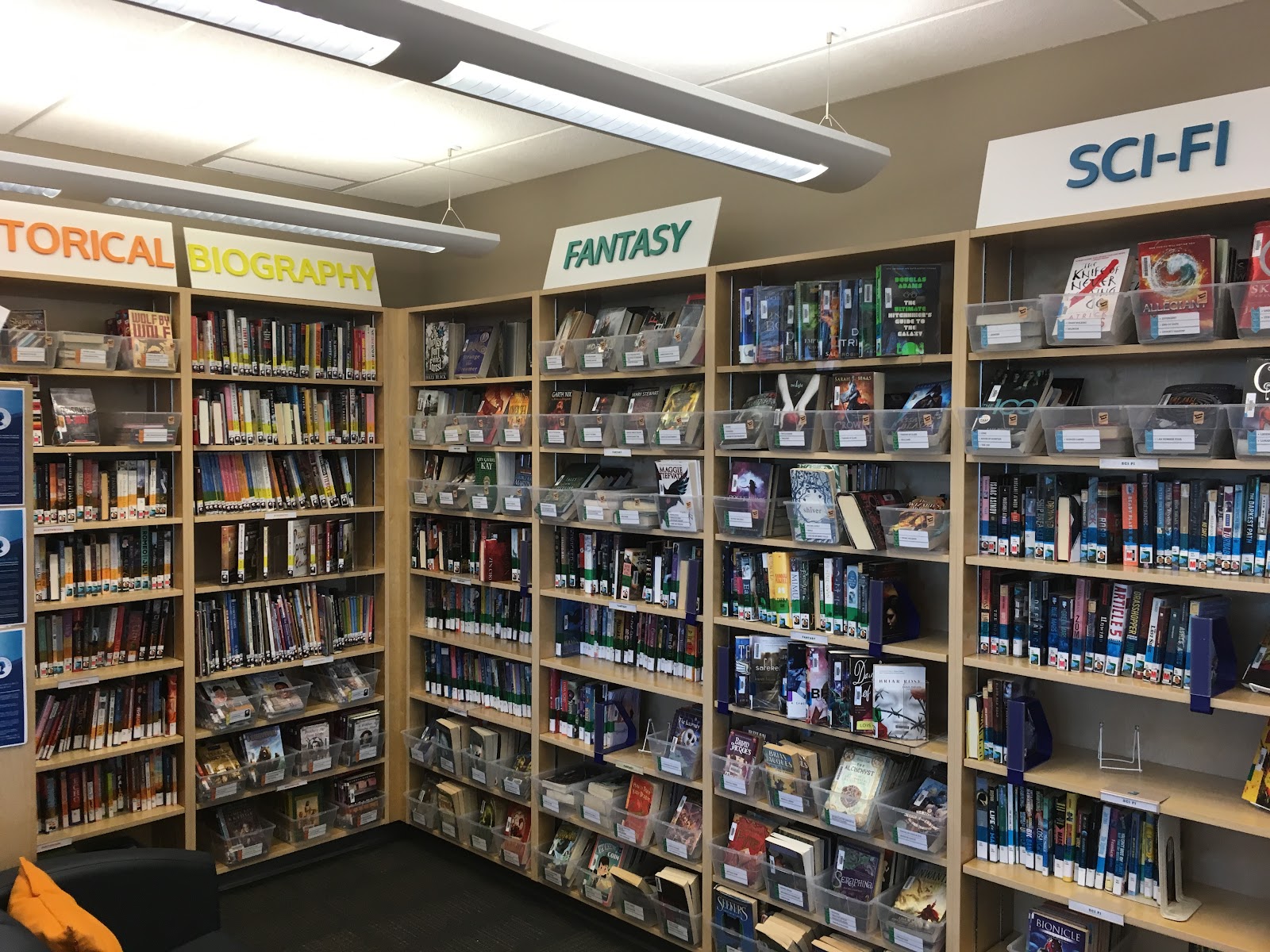
Our Fiction section in our library used to be sorted simply by reading level (E (Early Reader), Juvenile, Young Adult, or Mature) and shelved alphabetically by author’s last name. When a library is genrefied, the books are shelved in genres, similar to a how a bookstore would operate.

Why Did We Decide to Genrefy our Collection?

One of our main reflections after analyzing our circulation statistics was that students may not be checking out books because they were not discovering them. They were often defaulting to series because we knew the series. We found that students were more likely coming to us asking for book recommendations based on genre and not on authors (the way our fiction system was originally organized). When students asked us for a recommendation for a good mystery book to read, we often defaulted to the first titles that came to our mind because we could find them on the shelves and many great titles were being overlooked. After genrefying our collection, when a student asks us for a great mystery read, we can direct them to the Mystery section where they can browse the shelves and discover titles they may not have discovered before. This plays on the browsing philosophy book stores employ - organize the books by genre to make it easy for patrons to browse based on their interest in a specific genre and discover books on their own.

How Did We Genrefy our Collection?

The process of genrefying our collection was quite a long one and took several months.

1.)We completed an evaluation of our collection and weeded titles that were damaged, outdated, or no longer needed in the collection - this allowed us to know how many books we were dealing with.
2.)We decided on our broad genres. For the purposes of our library we decided on the following genres:
  • Realistic 
  • Historical
  • Biography (not technically fiction, but we felt the biographies and autobiographies would get more circulation if shelved in the fiction section).
  • Fantasy
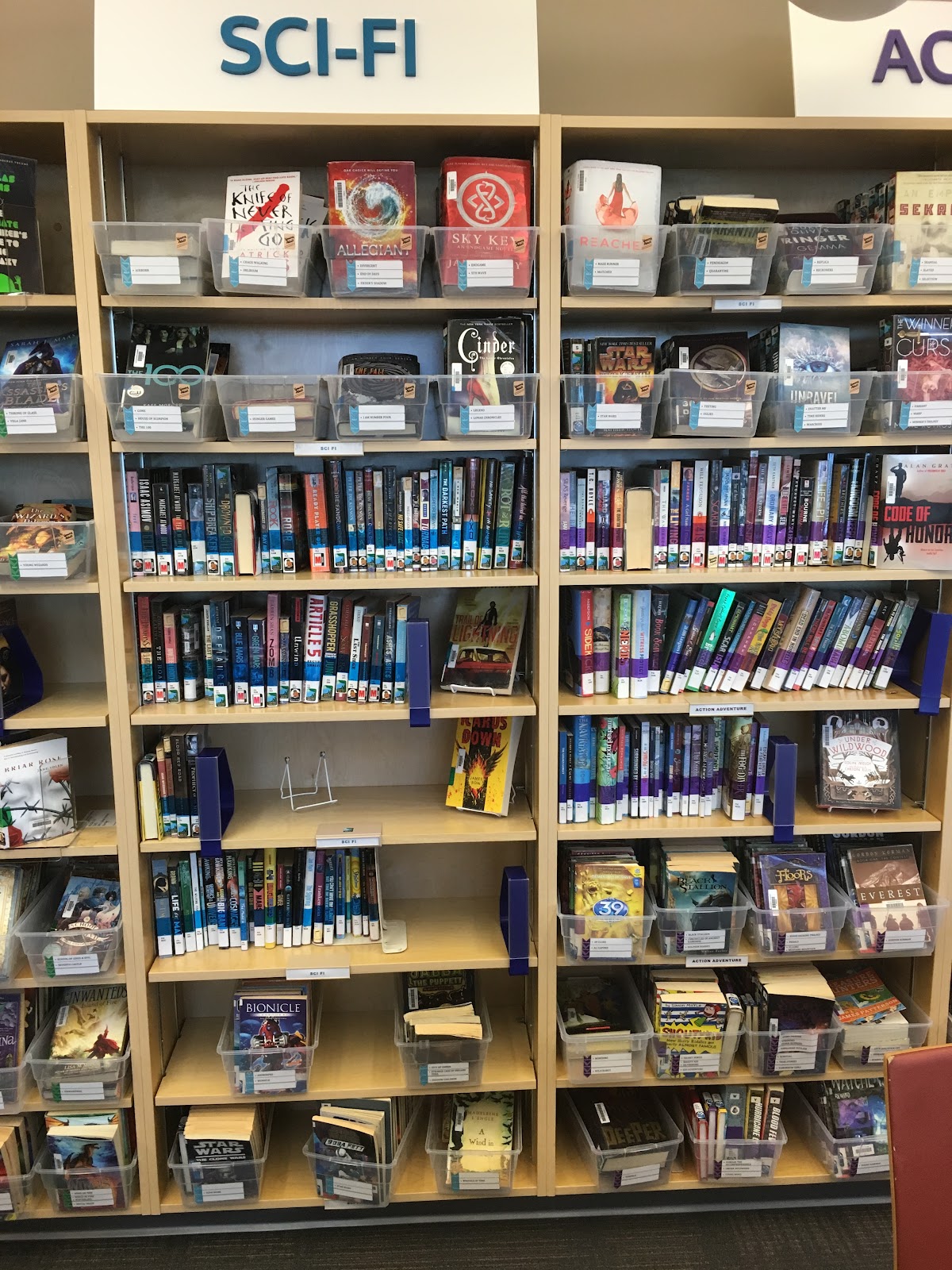
  • Sci-Fi
  • Action
  • Mystery

3.) Once we decided on our genres, we developed a system of labelling we felt would work for our students. We assigned each genre a colour, purchased spine labels in each colour that we would put on the book spines of each books so students knew which genre it belonged to and so people shelving would know what section to put the book in and ordered signage for the library with the genre names in the appropriate colour.

4.) We then started the task of sorting each book into a genre - which took months! For some books it was easy, but for other books it was more difficult (I am looking at you Vonnegut!) For those books that didn’t easily fit into a genre easily, we went with the genre we thought would make the most sense for our student body with the caveat that we could always change it later if our decision wasn’t working. 

5.) The last task was the most time consuming. Once we sorted each of the books into a category, we had to map out our shelf space with the number of books in each category to figure out what should go where. For example, our Realistic section was quite large, but our Mystery section was significantly smaller. Besides letting us know how much shelf space was needed, this step of the process also gave us an excellent visual of sections of the collection where we need to develop more choice for students. We needed to ensure we assigned enough shelves for the number of books we had, but also allowed room on the shelves for the section to grow as it wouldn’t be a simple matter of just shifting books once the collection was genrefied and the shelves were labelled. Once we had the shelves mapped out, we added the colour coded stickers to each book, sublocated them in the library catalogue to the appropriate genre, and shelved them.

What Have Been Some of the Benefits We Have Noticed Since We Have Genrefied Our Collection?

We have found right away that some of the books that have never been checked out have started to move from our shelves. When a student asks for a Sci-Fi book, we can easily direct them to the Sci-Fi section and they are started to explore more rather than just defaulting to a popular series. Because of this, students are starting to discover some of our previously hidden gems. We have also found that students are starting to explore the library more and are challenging themselves to explore genres they may have never considered before.

What Have Been some of the Challenges?

The largest challenge for us seems to be what to do with authors that write across genres and we decided we had to deal with this on a case by case basis on what would be best for our students. For some authors, like Roald Dahl, we decided to keep all of his books together in the genre the majority of the books were written in. We did this because our students were more likely to ask for Roald Dahl books based on the author because he was one they were familiar with. For other authors we decided to break their books up across genres because the students were not recognizing their books by the name of the author, rather they were more likely to recognize them by the genre they are in. Making these decisions took some time and we likely will have to make some adjustments as time goes by.

Overall, despite the large amount of work involved, genrefying the fiction section of our library has been a worthwhile endeavour that has revitalized sections of our collection and has allowed our students to explore our collection and to find their next great read with greater ease.


Friday, 11 January 2019

The Reluctant Reader


The Reluctant Reader


Contributed by Maureen Belliveau


They stand glass eyed looking at the book spines, a zombie state has overtaken them. They are frozen in the process and do not know how to navigate out.

The library is not a welcoming environment, to the reluctant reader, it is more of a jail sentence, it is Superman’s Kryptonite. The question is how do you as the librarian make reading an enjoyable experience? How do you get the reluctant reader to want to read and love reading?

STEP 1
- Read the books you think the Reluctant Reader may want to read


STEP 2
- Graphic novels are easier to read, less intimidating


STEP 3
- Make a connection with the Reluctant Reader and ask what kind of TV shows or movies they like to watch. (Give examples - horror, comedies, science fiction, fantasy, romance etc.)


STEP 4
- Show many books for them to choose from


STEP 5
- Recommend books - Sell, sell, sell.


STEP 6 - I usually recommend books I have read and I make a promise that if they do not like the book I will buy them lunch. ( I have never had to purchase lunch)


STEP 7 - Check in with the reader to see how they are enjoying the book


Ask yourself:


Why such reluctance?


Is there an underlying problem?


How can I be the bridge to help this reader?


Do I need lower level readers? (Hi interest, low vocabulary)


Do I have the a variety of options available? ( audio books, online)


Engaging the reluctant reader is a challenge and a rewarding experience at the same time.

Thursday, 27 December 2018


Killin’ It: The Library Orientation Murder Mystery


Contributed by Gloria Piovesan, Collingwood

The Fifth Annual Halloween Murder Mystery inspired six rotations of English 8 classes to introduce themselves to the library while they solved the murder of Headmistress Asil Snave (our Head of School Lisa Evans spelled backwards!)

Eight clues led students to check out the physical collection, use the catalogue, and discover a variety of work-space options.

Students were thoroughly engaged and invested, and are now far more comfortable with their library.

Oh, and if you are wondering who did it? Of course it was the teacher-librarian. If you would like more information, email morvenlibrary@collingwood.org


Tuesday, 18 December 2018


Contributed by Mary Duffy, Little Flower Academy

Word Literary Festival at VPL


This year our school library collaborated with Word, Vancouver’s free annual literary arts festival. This fest which occurs during the last weekend in September brings together authors, publishers and the public for a celebration of readers and writers. Held around and inside the central branch of the Vancouver Public Library this was one of their rainiest but also busiest festivals in its over 25 year history.

We publicized the event both in the library and on our website recruiting numerous teen volunteers as greeters and assistants to give information or to help with set up and take down. Teens not only obtained valuable service hours but were also able to meet and mingle with a wide range of authors. Many of the students choose to remain after their shift or come earlier in order to attend sessions. There were several excellent workshops hosted inside VPL with published writers offering some inspiring sessions throughout the day. A favourite was one hosted by award winning poet, Daniela Elza who presented prompts to inspire attendees resulting in the creation of some unique poems, stories and reflections.

I was invited to host on the children’s stage and had the honour of introducing authors such as the very prolific and talented Kallie George who shared her new chapter book based on Anne of Green Gables and Jane Whittingham, an LFA alum who is now a VPL children’s librarian as well as an author with Pajama Press. She read her picture book, Wild One which delighted young and old alike - You can check Jane’s work out on her blog Jane the Raincity Librarian.

https://www.raincitylibrarian.ca/


Authors ranged from adult non fiction writers such as Andrea Warner who read from her new authorized biography of Buffy Ste. Marie to master chef Vikram Vij talking about his journey to the best new adult, young adult and children’s writers.

Next year the festival will have a special focus on Indigenous authors. It’s an excellent opportunity for students, families, librarians and teachers to enjoy a day which features authors and activities for all ages. Interactive opportunities such as workshops and a chance to volunteer helps to ensure that this fest is a particularly lively literary celebration.

Wednesday, 12 December 2018

Bookworms - Student Book Reviews


Bookworms - Student Book Reviews


Contributed by Carmen Moser, Southridge Senior School

Students recommending books to other students is perhaps the most effect endorsement of any text. This is hardly earth shattering news, and indeed, many of you are probably rolling your eyes thinking, “Tell me something I don’t know.” But, understanding this and being able to harness it are completely different. While students will sometimes talk to those in their close circle about what they’re reading, the discussion generally does not extend beyond that crowd. The birth of the Bookworms program at the Southridge Senior Library originates from a desire to encourage students to be able to share recommendations beyond just their friend group.

In the Alderdice Library, our catalogue (Follett Destiny) has the capacity to post student reviews. This is a vastly underused component of the program, and something I wanted to encourage. Yet, I wasn’t satisfied with students merely posting a star rating out of five (the first reviewable option) followed by, “It was good” in the comments section. I spoke to students and parent volunteers about the teen book reviewers in the Surrey Public Library system in order to mirror some of the elements that had made that program a success.


Most importantly, students needed to have an incentive. As I was asking them to complete fairly comprehensive reviews (both a long version to be posted on the catalogue, and a short version to aid with in house marketing) there needed to be a reward that reflected the work they were producing. The public libraries offered a volunteer hour for their reviews, so to compete, I offered two service hours for each review posted and approved. Furthermore, students in our club also get first dibs on any new books that come into the library, so they can read and review books before they’re even out for general circulation. By having these perks as part of the program, there is a tangible benefit to the commitment of writing and posting the reviews.


As the reviews exist primarily online via the catalogue, I wanted to be able to promote the work of the Bookworms in our physical space. To that end, each book that has a review posted online also has a sticker on the physical book. We also have an area where some of the books are displayed. Finally, I use shelf-talkers to display the short reviews. Using a variety of ways to show that a book has been read and reviewed has encouraged students in the library to take a closer look at those titles.

As the program is still young, advertising it to students is crucial if it is going to grow and achieve its purpose: students promoting books to students. Currently there are bookmarks and posters throughout the school. Students are also shoulder-tapped, and the club is mentioned in all of the book talks for the English classes. Going forward, I’m looking at some swag for prolific reviewers, in addition to having an ambassador make mention of the program at assemblies. While the group is purely online right now, optional meetings to talk about books with other bibliophiles might also be a good way to build momentum.

Overall, the Bookworms program has been a successful way to have students promote books to one another and I’m excited at the possibilities going forward.

Monday, 10 December 2018

Opportunities from Disaster: Dismantling the School Library


~Contributed by Heather Middleton - Aspen Grove School

Opportunities from Disaster: Dismantling the School Library


Mid-September this year, a portion of our library collection of over 15,000 books was packed and placed into an off site storage unit to accommodate a grade three class after their classroom had been flooded...

From this disaster, we had an opportunity to make changes as we would be starting afresh when the books returned. On the advice of a colleague, whose school had moved their library in previous years, observed that this was our opportunity to make a change for our school library. It was opportunity for change not only in library configuration in the placement of the shelving but also opportunity in making changes in the collection itself. Great advice from a librarian colleague!

Throughout the next month, access to the library materials was provided on a limited basis. By delivering books in book baskets to our Junior classes during their scheduled library times younger groups still connected with the library. Thankfully our library had a portable scanner and we had access to Follett’s Destiny Quest online.

While the school library was unavailable, older students began using the local Regional Library more frequently, and, students also began sharing their personal copies of books with friends. The entire school community showed initiative to keep their reading active. Classroom teachers added books to classroom libraries to allow students to take home personal reading material,

All of the school community was coping with the closure by providing more choices for encouraging readership rather than simply sending a class to the library. Other solutions, such as the student run traveling library. Our school library in the previous year, had purchased a travelling library of 200 or more books from scholastic books to encourage more reading circulation from its Middle Years students.The traveling library was stored in book bins, then delivered into one of the Middle Years classrooms, and books were circulated by students on their own initiative.

Partially due to the loss of their school library, action was also taken by one of Middle Years Advisory groups who organized a book drive to provide books to students in schools with more limited access to literacy and literacy has become been part of their service project.

What had taken one day to dismantle took five days to recover. The shelves had been removed from the cases and it took hours to find which shelf fit into what unit. The packers who had no experience with the library system hadn’t boxed books in alphabetical order although the boxes had indicated an alphabetic system. However, finding a new order from disorder, resulted in a small but more efficient use of space. In it’s rebirth, the library now extended into the school halls, and the school community as a whole has become even more supportive of its resources.

Friday, 7 December 2018

Developing Empathy


Contributed by Jaya Van Praagh- Southpointe Academy


Developing Empathy

The new Wellness Series written by Susan Verde and illustrated by Peter H. Reynolds are a great addition to our library collection. They include the following picture books: 

I am Human: A Book of Empathy (October 2018)

I am Peace: A Book of Mindfulness (September 2017)

I am Yoga (September 2015)


The messages in these books are relevant to students of all ages and many different connections can be made. It’s nice for the younger students to recognise both the author and illustrator through the use of the same format for each book in the series as well as from other books they have both written and/or illustrated.

I read the book, I am Human, to many different groups of students from Kindergarten to Grade 5 in the last week and had many meaningful discussions.

With Kindergarten and Grade 1 students, we tied it into a discussion as to why we have a Remembrance Day Ceremony and the importance of working together towards a peaceful world. The central idea for our current Grade 1 unit of inquiry is “Identity is expressed through cultural diversity” and the ideas in the story tie into the importance of shared values and beliefs.

Grade 4 students are currently learning about how our personal identity can be influenced from choices and society. For these classes, as well as our Citizenship Club students (Grades 3-5), the messages in this book are a reinforcement of ways to take responsibility as a global citizen and how small actions of care and compassion can make a big difference.